AI adoption is accelerating—and with it, the number of AI agents inside your organization. These autonomous systems now handle everything from customer support and sales enablement to analytics, workflow automation, and operational decisioning.
Done right, agents deliver speed and scale. Done loosely, they create a quieter problem with loud consequences: agent sprawl. When agents proliferate without visibility or guardrails, organizations drift into operational complexity, runaway spend, and compliance exposure—often before leadership realizes what’s happening.
What Is Agent Sprawl?
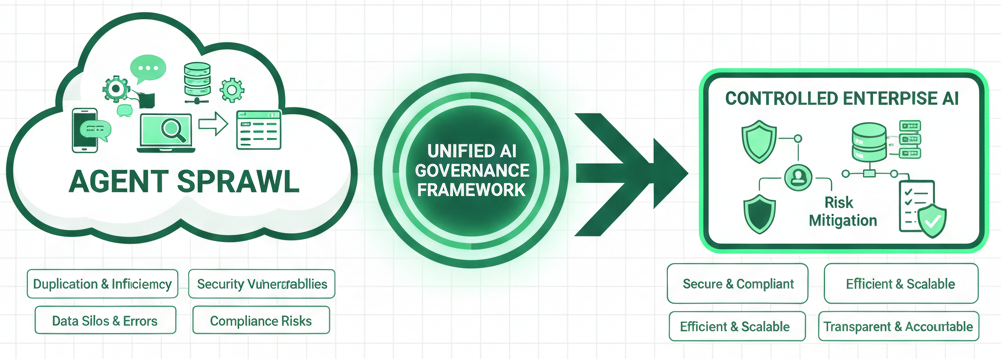
Agent sprawl happens when AI agents multiply across teams and departments without centralized governance, shared standards, or an approved operating model.
It typically looks like this:
- Redundant agents solving the same problem in parallel
- Hidden costs from duplicate licenses, LLM usage, and compute
- Shadow AI: unapproved tools and workflows that bypass security controls
- Fragmented initiatives that make impact and ROI hard to prove
In short: a strategy that started as “move fast” becomes hard to manage, expensive to run, and difficult to defend.
Why Executives Should Care
For founders and C-level leaders, agent sprawl isn’t just an efficiency issue—it’s a leadership risk.
Financial leakage
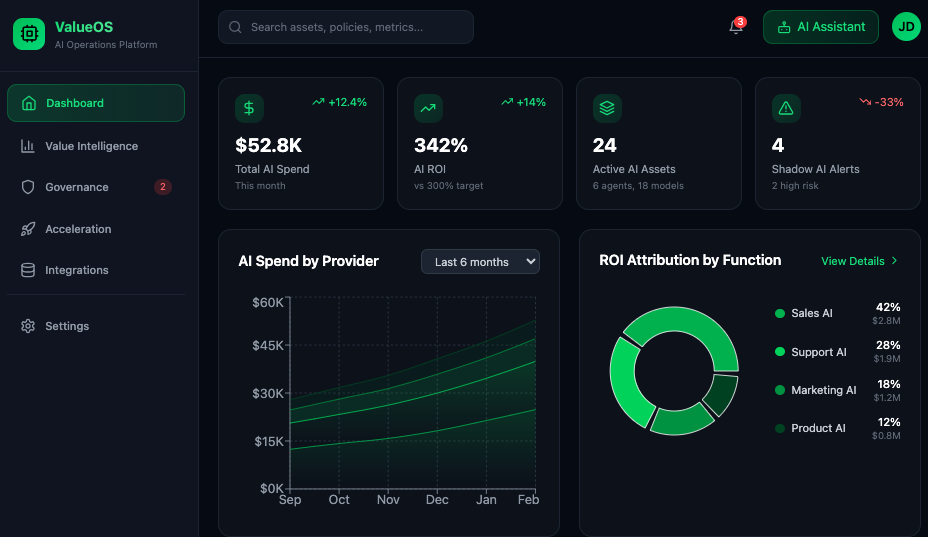
Redundant agents, overlapping vendors, uncontrolled token spend, and ad hoc experimentation can quietly inflate costs—sometimes dramatically—without appearing in a single budget line.
Security and compliance exposure
Unapproved agents may access sensitive data, connect to unauthorized systems, or retain information in ways that violate policy. The result can be data leakage, audit failures, and regulatory risk.
Strategic misalignment
When agents are deployed in silos, they rarely map cleanly to business objectives. Boards and investors ask, “What’s the ROI?” and the organization can’t answer with confidence—because nobody owns the full picture.
Agent sprawl doesn’t just threaten margins. It undermines your ability to govern, measure, and scale AI responsibly.
How to Maintain Control Without Killing Innovation
The goal isn’t to slow teams down. It’s to give them a safe runway—so experimentation turns into durable value instead of permanent sprawl.
1) Centralize agent governance (without centralizing all development)
Create a single system of record for every agent: owner, purpose, data access, integrations, environment, cost center, and risk tier. Standardize baseline policies for access control, logging, and deployment.
2) Detect and eliminate Shadow AI
You can’t manage what you can’t see. Continuously monitor for unauthorized tools, unsanctioned LLM workflows, and unregistered automations—then bring them into compliance (or shut them down).
3) Prioritize high-impact agents—and consolidate the rest
Not every agent deserves production-grade support. Focus on agents tied to measurable outcomes (revenue, cycle-time reduction, cost takeout). Retire, merge, or redesign agents that duplicate functionality.
4) Make ROI attribution non-negotiable
Every agent should have a clear KPI, baseline, and measurement plan. If an agent can’t be tied to outcomes, it remains an experiment—not a program.
5) Scale through a 90-day Agent Sprawl Governance sprint
Use short, outcome-focused cycles to launch, measure, harden, and expand agents safely. This creates momentum for teams while giving leadership predictable checkpoints on cost, risk, and value.
The Payoff of Fixing Agent Sprawl
Organizations that proactively address agent sprawl typically see:
- Lower operational costs by eliminating redundancy and controlling usage
- Stronger compliance posture through standardized controls and auditability
- Clear ROI visibility for executives, boards, and investors
- Faster, safer scale as successful agents move from pilot to enterprise rollout
Governance doesn’t reduce innovation—it prevents innovation from turning into entropy.
Conclusion
AI agents are powerful. But without oversight, they multiply into unmanageable complexity—creating cost, compliance risk, and an ROI story you can’t clearly tell.
The winning approach is straightforward: visibility + governance + outcome-based execution. When you combine a real governance framework with fast implementation sprints, you keep teams moving quickly while ensuring the enterprise stays secure, measurable, and scalable.
In the AI era, the winners won’t be the companies that deploy agents the fastest.
They’ll be the ones that control, measure, and scale them wisely.
If you want to be one of this companies, book a free assessment and we'll help you turn your agent sprawl into a unified governed system that delivers value.