AI adoption is exploding—but ROI proof is not.
Across industries, organizations are investing heavily in copilots, agents, and automation. Yet a familiar pattern keeps repeating: pilots multiply, dashboards get busier, and executive confidence gets weaker. When budget season arrives, the questions sharpen:
- What did we get for this spend?
- Where did AI move revenue, cost, or productivity—specifically?
- Which initiatives should we scale, and which should we kill?
For many teams, those answers are hard to produce—credibly, consistently, and in a way the board will accept. That’s the ROI attribution gap.
Why Traditional AI Metrics Don’t Satisfy the Business
Most AI projects are measured with technology-centric KPIs:
- model accuracy
- uptime and latency
- number of workflows automated
- number of agents deployed
- tokens consumed
These metrics matter to IT and data science teams. But they rarely answer the only question leadership is paid to care about:
“Did this create business value—revenue, cost reduction, risk reduction, or efficiency?”
A model can be accurate and still irrelevant. A bot can be deployed and still unused. A pilot can be “successful” and still fail the CFO test.
The Real Failure Modes Behind “Invisible ROI”
When organizations can’t demonstrate value, it’s usually not because AI is useless. It’s because the program structure makes ROI impossible to attribute.
Here are the usual culprits:
1) Fragmented initiatives
AI pilots often launch inside functional silos—sales, support, ops, finance—each with its own tooling and reporting. Even when value exists, it stays fragmented and never rolls up into a single, credible view.
2) Agent sprawl
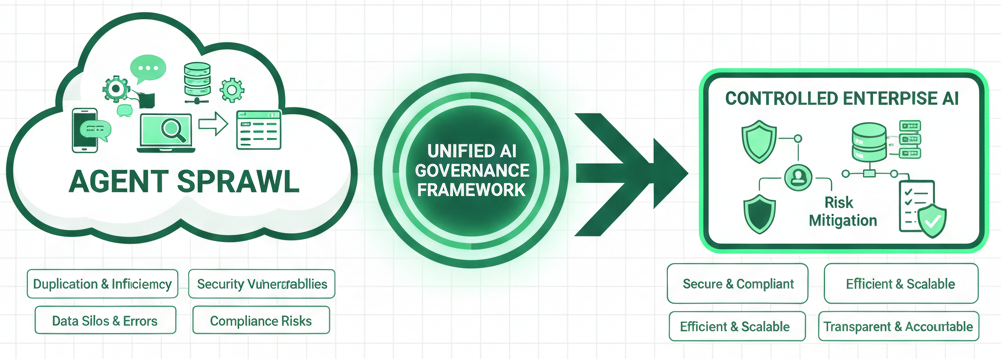
As teams experiment, agents proliferate. Redundant assistants, overlapping workflows, duplicated prompts, and competing tools create hidden operating costs—and muddy accountability.
3) Shadow AI
Unauthorized tools and ad hoc workflows quietly expand across the organization. They consume budget, introduce risk, and generate outcomes that aren’t measured—because no one is officially responsible.
4) Untracked go-to-market execution
Many organizations use AI to “improve GTM,” but fail to connect it to GTM outcomes like:
- shorter sales cycles
- higher win rates
- improved pipeline conversion
- increased rep capacity
- reduced time-to-quote / time-to-proposal
Without instrumentation and attribution, the story remains anecdotal.
The result: millions spent, but no board-ready proof.
The Missing Link: ROI Attribution
If you want AI to survive scrutiny—and scale—you need an ROI attribution framework that connects AI activity to business outcomes.
Not “AI performance.”
Business performance.
ROI attribution answers questions like:
- How much revenue did this deal-assist bot recover or accelerate?
- What cost did we eliminate by consolidating redundant agents?
- Which workflows created measurable cycle-time reduction—and where did that capacity go?
- What did inference cost, and what outcome did we buy with it?
In other words: it makes AI value traceable, auditable, and operational—not aspirational.
How to Move from AI Guesswork to Measurable ROI
Here’s a practical path that works across most organizations:
1) Map your AI landscape (yes, all of it)
Start with a complete inventory:
- active AI tools and vendors
- internal agents and automations
- pilots in progress
- usage levels by team
- inference spend (and who owns it)
- shadow AI detection where possible
If you can’t see the full footprint, you can’t measure the full impact.
2) Prioritize high-impact initiatives with a clear value chain
Focus on projects with a direct line to:
- revenue: pipeline, win rate, retention, expansion, pricing, deal velocity
- cost: labor hours, vendor consolidation, error reduction, rework reduction
- efficiency: cycle time, throughput, time-to-resolution, employee capacity
- risk: compliance, security, auditability, policy enforcement
Start with a few high-confidence wins. Early proof builds credibility and momentum.
3) Establish an operating framework (governance + measurement + accountability)
This is where most programs break down.
You need centralized visibility for:
- agent governance (who built it, who owns it, what it touches)
- policy and compliance
- usage and adoption
- outcome tracking
- consolidated reporting
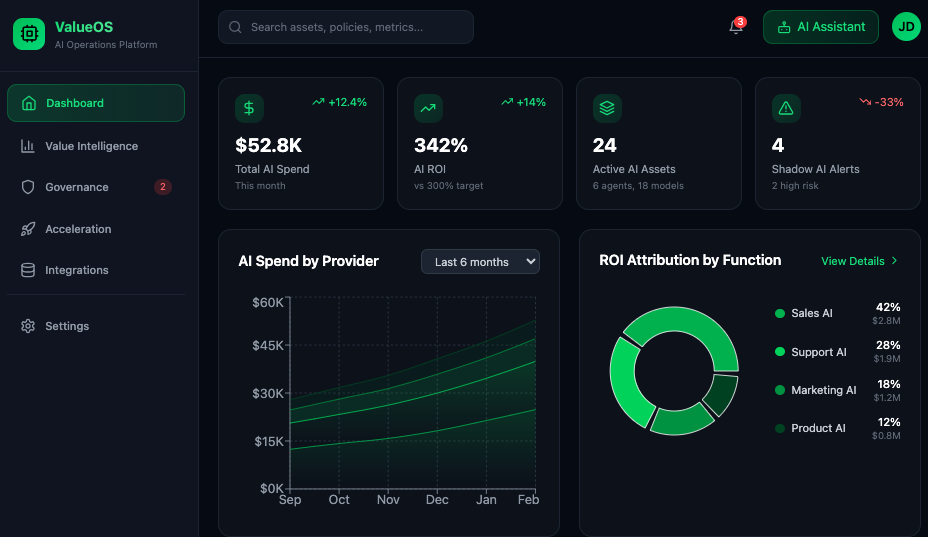
Platforms like ValueOS (or an equivalent internal operating layer) can provide that control plane—reducing sprawl while increasing accountability.
4) Measure outcomes—not inputs
Shift measurement from “what we deployed” to “what moved.”
Track:
- Revenue impact: influenced/accelerated ARR, recovered churn, upsell lift
- Cost savings: hours eliminated, vendor consolidation, reduced escalations
- Efficiency gains: cycle-time reduction × volume, throughput increases
- Quality/risk improvements: fewer defects, fewer compliance incidents, better audit trails
- Unit economics: cost per task, cost per outcome, inference cost per value
Then tie each metric back to the specific AI initiative that caused it.
5) Operate in 90-day value sprints
Long AI roadmaps kill ROI. Short cycles prove it.
Run a 90-day AI ROI Optimization sprint with:
- a defined baseline (before state)
- a measurable target outcome
- instrumentation from day one
- weekly review of adoption + costs + impact
- a scale/stop decision at sprint end
This turns AI from experimentation into execution.
The Payoff: What Changes When Attribution Works
Organizations that implement ROI attribution and governance typically see outcomes like:
- 3× higher measurable AI ROI
- 60% reduction in agent sprawl
- 25–60% reduction in LLM inference costs
- faster GTM execution and accelerated revenue growth
More importantly: leaders gain clarity, control, and confidence. AI stops being a budget line item and becomes a managed value engine.
Conclusion: In the AI Era, Proof Beats Hype
AI adoption is booming—but value remains elusive because most organizations measure the wrong things and run AI without a value operating system.
Traditional metrics focus on technology performance. Boards care about business performance.
The solution is a holistic ROI attribution approach—powered by:
- full visibility into the AI landscape
- governance that reduces sprawl and risk
- outcome-based measurement tied to initiatives
- rapid execution cycles that deliver proof quickly
In the AI era, speed alone isn’t enough.
The companies that win in the AI era are the ones that prove AI value faster.
Book a free assessment today and start unlocking your company's measurable AI ROI.